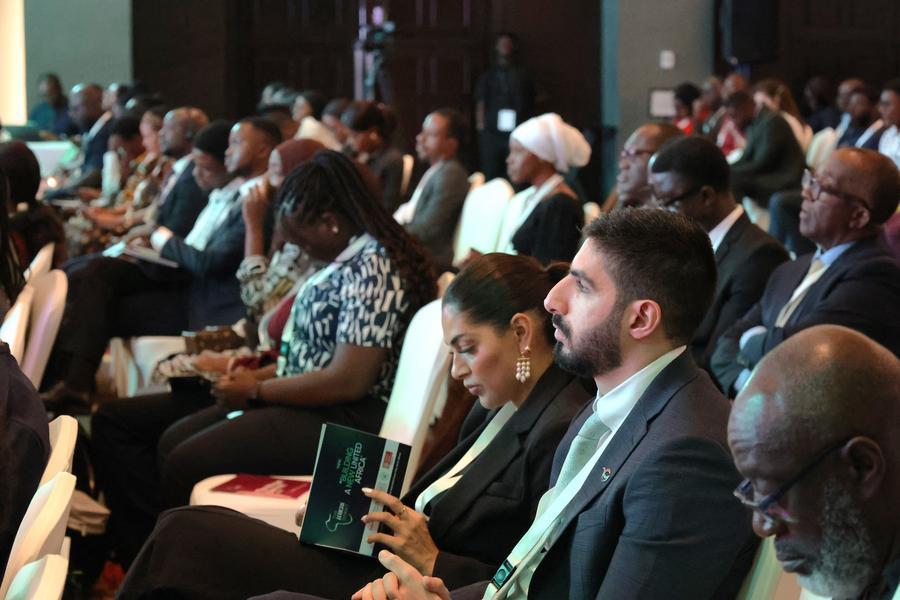
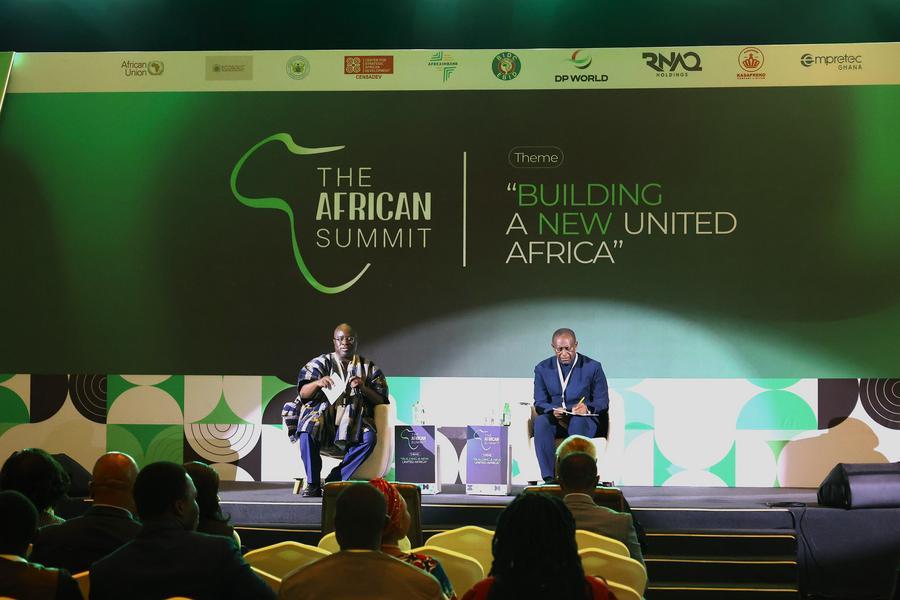
NAIROBI, Dec. 17 (Xinhua) -- The inaugural African Summit, themed "Building a New United Africa," opened Tuesday in Accra, Ghana's capital, bringing together policymakers and stakeholders from across the continent to build consensus on a more integrated, interdependent and interconnected Africa.
Confronted with both domestic and global governance pressures, African nations increasingly recognize that development is the master key to addressing persistent problems. There is a growing urgency to achieve strategic autonomy, address historical injustices, and accelerate continental integration.
Analysts note that only by working with other developing countries to advance modernization can African nations overcome governance bottlenecks, shape a more just and equitable global governance system, and ultimately achieve shared development.
AFRICAN MOMENT AMID CHANGES
Addressing the opening ceremony of the African Summit, Ghana's Foreign Minister Samuel Okudzeto Ablakwa said Africa "continues to grapple with fragmentation, weak intra-African trade, infrastructure deficits, limited industrial integration, and excessive dependence on external markets and systems."
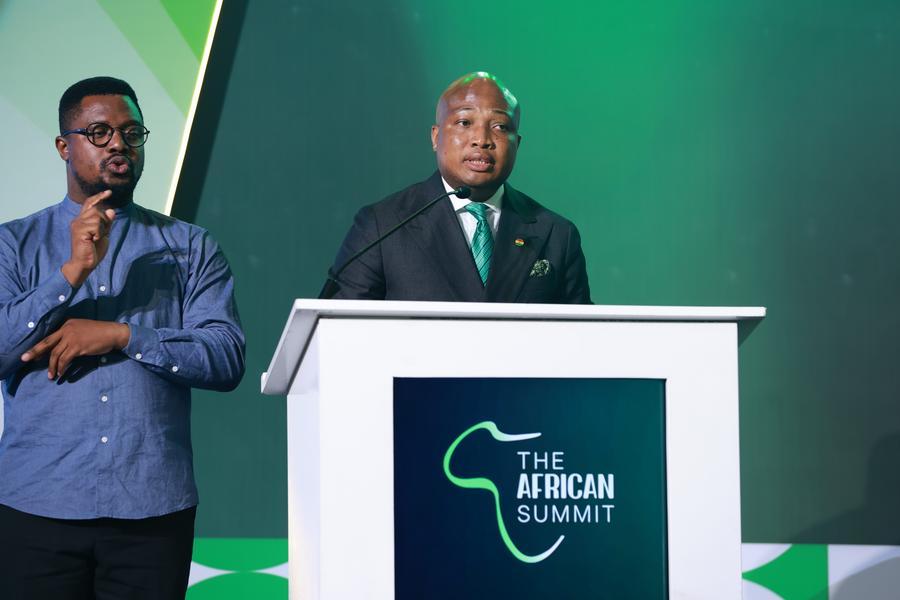
"The global environment within which Africa must pursue its integration agenda is undergoing a rapid, profound transformation," he said, stressing that the continent must shift from being a passive observer to an active shaper of global outcomes through a united African voice, coordinated diplomacy and collective economic action.
His remarks resonate against a backdrop of mounting challenges across the continent. African Union Commission Chairperson Moussa Faki Mahamat warned at the 80th session of the United Nations General Assembly that the continent continues to face persistent conflicts, interstate tensions and surging violent extremism, compounded by dwindling crisis management resources and weakening international solidarity.
In late November, the G20 Leaders' Summit was held in Johannesburg, with a focus on advancing the development agenda of the Global South, particularly African countries. In a departure from tradition, the summit adopted a Leaders' Declaration at the opening ceremony, rather than at the close.
However, the push for consensus encountered resistance. The United States, which refused to attend the summit, insisted that it would reject any outcome document "under the premise of a consensus G20 position without U.S. agreement."
Despite this, participating leaders stood firm, and the declaration was ultimately adopted with overwhelming consensus, underscoring the need to address global challenges through multilateral cooperation and calling for stronger support for developing countries to advance inclusive growth and sustainable development.
"The mere fact that we have an agreed declaration shows that the world is embracing multilateralism, and the world is embracing cooperation and collaboration," Vincent Magwenya, spokesperson for South African President Cyril Ramaphosa, told Xinhua.
The summit marked the first time the African continent hosted a G20 Leaders' Summit. African countries, along with other Global South nations, played a pivotal role in steering the meeting toward positive outcomes, placing Africa's development priorities, unique perspectives and homegrown solutions at the center of discussions on global governance reform.
This "African moment" at the G20 summit reflects the collective rise of Africa and the Global South amid accelerating global transformations.
The IMF projects that sub-Saharan Africa's economic growth will exceed the global average, reaching 4.1 percent in 2025. Substantive progress has also been made in building the African Continental Free Trade Area (AfCFTA), with 47 countries having ratified the agreement. The World Bank estimates that the AfCFTA, whose tariff reductions and regulatory coordination are gaining space, is expected to generate about 450 billion U.S. dollars in additional economic output by 2035, lift 30 million people out of extreme poverty, and boost Africa's overall exports by nearly 29 percent.
Humphrey Moshi, director of the Center for Chinese Studies at the University of Dar es Salaam in Tanzania, said Africa is now at the center of the global development agenda, demonstrating the continent's resilience and deepening ties with the Global South. With a shared history of overcoming colonial oppression and achieving independent development, Africa is poised to shape its future.
AFRICAN SOLUTIONS TO GOVERNANCE CHALLENGES
In late November, the armed forces of Guinea-Bissau staged a coup, removing President Umaro Sissoco Embalo from office. About one week later, a mutiny broke out among some soldiers in Benin, though authorities swiftly contained the situation. In eastern DRC, fighting flared again in December, leaving more than 400 people dead and over 500,000 people displaced.
These political shocks have heightened regional alert. Omar Touray, president of the Economic Community of West African States, announced a "state of emergency" across West Africa on Dec. 8.
Analysts note that the causes of unrest are varied but are often intertwined with colonial legacies, terrorism, lagging economic development and other governance challenges.
External shocks have further compounded these pressures. In April, the United States imposed additional tariffs on Lesotho, leading to the reported cancellation of nearly 80 percent of the country's textile export orders within weeks, prompting the government to declare a two-year "state of national disaster." Similarly, following U.S. tariff hikes on South Africa, the country's auto exports to the United States plunged sharply, with declines of 80 percent in April and 85 percent in May.
To cushion these shocks, analysts stress that African countries should further strengthen cooperation with developing nations by leveraging international collaboration to advance Africa's development, amplify the Global South's voice in international affairs, and promote a more just and reasonable global governance system.
Madagascan economist Julien Rakoto called for regional integration and a "strategic refocusing" toward African markets, particularly through the AfCFTA.
During the African Union Summit in February, leaders reviewed progress on the AfCFTA and expressed hope that by advancing regional integration and deepening regional integration, Africa could harness its large population and unified market to drive homegrown growth, helping address structural vulnerabilities, governance deficits and weak industrial foundations, and gradually overcoming persistent governance challenges.
At the African Summit, Ghana's Foreign Minister Ablakwa said the AfCFTA, once fully implemented, has the propensity to pull millions of Africans out of poverty, create jobs for the continent's youth, expand industrial capacity, and enhance Africa's bargaining power in the global economy.
He stressed that the success of the AfCFTA will depend on "our collective resolve to dismantle non-tariff barriers, harmonize regulatory regimes, invest in trade-related infrastructure, and support small and medium-sized enterprises to compete effectively across borders."
AFRICAN VISION UNITING GLOBAL SOUTH
On Dec. 2, an ocean-going vessel carrying 200,000 tonnes of iron ore departed Guinea's Port of Morebaya for China, marking the first shipment from the Simandou iron ore project and representing the full launch of the "mine-railway-port-shipping" industrial chain under the China-Africa cooperation framework.
Calling its launch a landmark moment in the country's development history, Guinea's chief of staff to the president, Djiba Diakite, said the Simandou project -- a world-class iron ore deposit -- represents a long-cherished dream of the Guinean people and a powerful engine for national transformation.
Similar visions are taking shape across the continent. In November, the Tanzania-Zambia Railway Authority rehabilitation project was officially launched. Once completed, it will link southern and eastern Africa's railways, highways and ports, advancing regional infrastructure connectivity.
Frank Tayali, Zambia's minister of transport and logistics, said that the railway's revitalization aligns with the government's vision of becoming a land-linked nation and a logistics hub in southern and central Africa. The railway, known as "the road to freedom," is expected to boost regional trade, create jobs and support shared prosperity.
Peter Kagwanja, chief executive of the Africa Policy Institute, a Nairobi-based pan-African think tank, said landmark infrastructure projects such as Mombasa-Nairobi Standard Gauge Railway and the Nairobi Expressway have significantly improved local livelihoods, standing as "vivid examples of China-Africa cooperation."
The year 2026 will mark the 70th anniversary of the establishment of China-Africa diplomatic relations and the China-Africa Year of People-to-People Exchanges. At the Global South Media and Think Tank Forum China-Africa Partnership Conference in November in South Africa, participants engaged in in-depth discussions on China-Africa cooperation amid profound global governance changes and widely agreed that deepening cooperation across sectors and jointly advancing modernization would ignite a new wave of Global South modernization.
Kenyan economist James Shikwati said in a written interview with Xinhua that amid the accelerating rise of the Global South and deepening multipolarity, China's pragmatic, inclusive and development-oriented approach to cooperation offers the Global South viable alternatives to traditional Western models. With a pragmatic approach of non-interference and support, China enables other countries to explore development models suited to their own needs.
"The Global South must not speak in fragments. Our strength lies in unity," said Leslie Richer, director of information and communication at the African Union, stressing that the priority is to align efforts into a unified strategic voice to shape global decision-making. (Video reporters: Gao Jianfei, Dai He, Zeng Tao, Xu Jiatong, Chen Wei, Xu Ruiqing; Video editors: Luo Hui, Zhu Cong, Cao Ying, Wang Han.)■