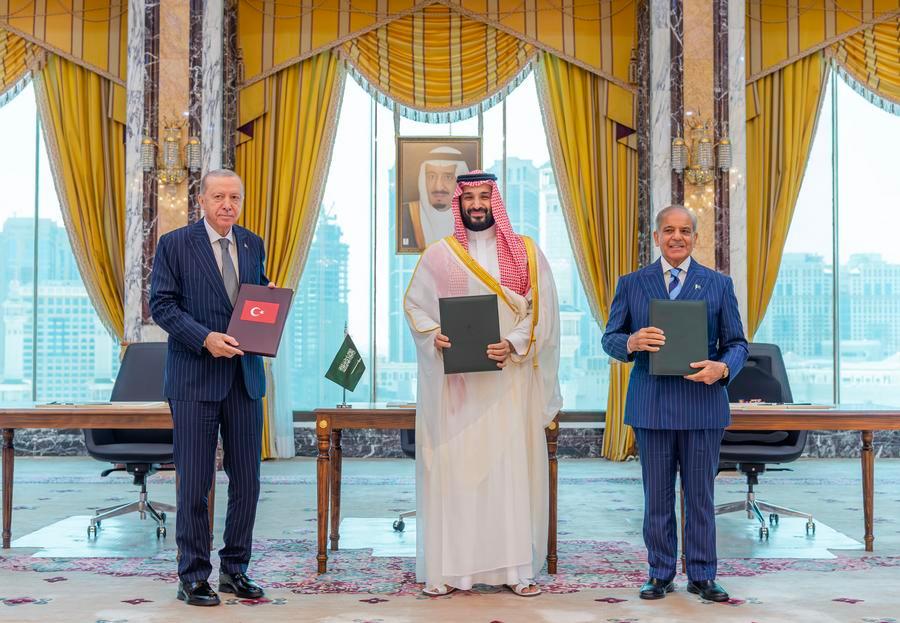
ISTANBUL, Aug. 11 (Xinhua) -- The recently signed Makkah Joint Defense Agreement among Türkiye, Saudi Arabia and Pakistan underscores a significant shift in Middle East security dynamics, analysts say, as regional powers seek greater autonomy over their security arrangements.
The deal, signed Friday in the Saudi city of Makkah, stipulates that any armed attack against one of the three countries will be considered an attack against them all.
Following the signing ceremony, Turkish President Recep Tayyip Erdogan stated the pact was based on "collective deterrence" and the right to self-defense under Article 51 of the UN Charter. In an interview with local media, Turkish Foreign Minister Hakan Fidan described the mutual defense clause, a key provision of the agreement, as "technically identical" to NATO's Article 5 on collective defense.
Beyond the wording of the agreement itself, analysts see the pact as a sign of a broader reassessment of the security architecture in the Middle East, particularly the role of the United States.
Baris Doster, an international relations professor at Türkiye's Marmara University, emphasized that the move is a direct response to a shifting regional order.
"The diplomatic convergence among Ankara, Riyadh and Islamabad accelerated with recent developments involving the United States, Israel and Iran," Doster told Xinhua. "Needs change, and consequently, alliances change. This new pact must primarily be evaluated in the context of these changing regional power dynamics."
The regional conflict involving the United States, Israel and Iran, analysts say, has further exposed vulnerabilities in the existing security paradigm.
Following the joint U.S.-Israeli strikes on Iran on Feb. 28, nearly all Gulf states with military ties to the United States found themselves drawn into the conflict.
Canan Tercan, a scholar at Istanbul Aydin University, said the conflict demonstrated that the United States could not fully protect the Middle East.
"Yes, there are U.S. bases here, but how much did they protect? It is a massive question mark. Regional countries had to overcome this vulnerability with new partnerships. We can essentially summarize this as one of the main reasons for the Makkah agreement," she told Xinhua.

Against this backdrop, the agreement underscores a growing emphasis on strategic autonomy among regional countries. While Erdogan has stressed that the agreement "does not target any country," emphasizing deterrence rather than confrontation, viewed from within the Middle East, it also represents an effort by regional actors to recalibrate the regional balance of power.
According to Doster, regional balancing is the core driver behind the agreement. "This agreement was primarily established to balance Iran's regional weight and influence," he believed.
The recent escalation in tensions between Saudi Arabia and Yemen's Houthi group has also tested Riyadh's rapprochement with Iran, which supports the Houthis.
While the agreement's political implications for the region should not be underestimated, analysts say its prospects for effective implementation remain uncertain, with a number of procedural hurdles still to be addressed.
In recent days, the Houthis have claimed responsibility for multiple attacks on Saudi Arabia, one of the agreement's signatories. Yet the other parties to the agreement have refrained from directly intervening, suggesting, as Tercan noted, that its collective-defense provision does not automatically trigger a military response to every incident.
The provision does not mean automatic military responses to minor incidents, Tercan said, adding that Turkish military participation would strictly require parliamentary authorization rather than immediate deployment.
Beyond legislative procedures, experts stress the need to preserve the alliance's strategic autonomy.
Abdullah Agar, a Turkish security expert, warned against external manipulation. He cautioned that the three signatories must maintain their strategic autonomy and avoid being drawn into costly conflicts driven by great-power interests.
Bao Chengzhang, an associate professor at the Middle East Studies Institute of Shanghai International Studies University in China, noted that the agreement could face several challenges in its future implementation, including differences in the three countries' respective security priorities, pressure from the United States and the impact of developments in the regional conflict, among others.■