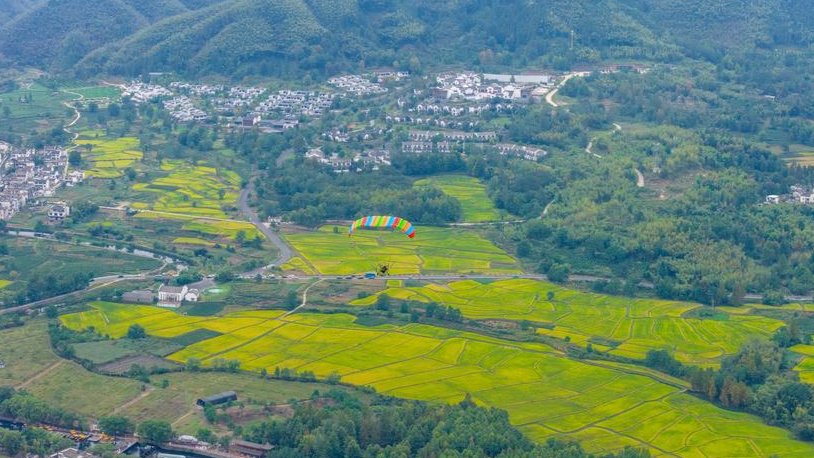
*Express delivery now reaches more than 95 percent of China's administrative villages. In some rural areas, however, getting a parcel to the village requires more than just one mode of transport.
*In Zizhong County in southwest China's Sichuan Province, for example, drones are being used on routes where winding roads make the last leg of the journey slow. This county currently has 131 drone routes serving 131 villages and plans to extend them to all 301 villages by the end of the year.
*Some 300 km away in Quxian County, drones are also being tested on the return journey, carrying farm produce from villages to township delivery points.
CHENGDU, Oct. 9 (Xinhua) -- Express delivery now reaches more than 95 percent of China's administrative villages. In some rural areas, however, getting a parcel to the village requires more than just one mode of transport.
In Zizhong County in southwest China's Sichuan Province, for example, drones are being used on routes where winding roads make the last leg of the journey slow. This county currently has 131 drone routes serving 131 villages and plans to extend them to all 301 villages by the end of the year.
Some 300 km away in Quxian County, drones are also being tested on the return journey, carrying farm produce from villages to township delivery points.
SHORTER WAY IN
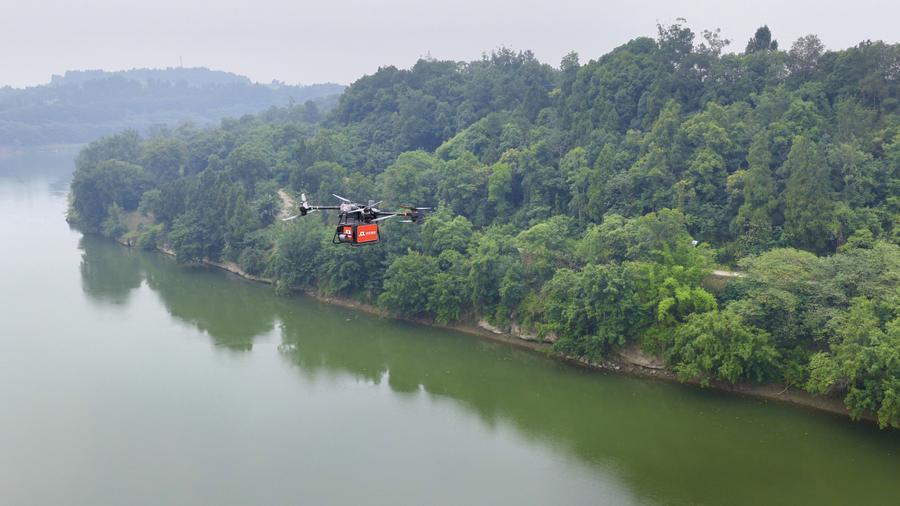
The route from Guide Town to Tongjiazui Village in Zizhong requires a delivery vehicle to travel 9.9 kilometers, which takes about 19 minutes, while a drone on this route covers 5.7 kilometers in roughly 6.5 minutes.
Around 85 percent of Zizhong is hilly, and many villages lie on slopes or in river valleys. Some remote villages previously received parcels only once every two or three days. In places without village service stations, residents sometimes had to travel to town to collect them.
Rao Yurong, who grows blood oranges in Yueliangxia Village, recently received a battery-powered sprayer she had bought online. It took the drone around seven minutes to fly from the township station to the village. Notably, Rao previously spent nearly an hour riding an electric bike to town and back to collect a parcel.
JD Logistics opened 78 routes in Zizhong in June and has since expanded the network to 131.
Drones handle only the last section of the journey. Trucks still carry parcels over long distances and from county-level facilities to township stations.
This service also relies on facilities and staff on the ground. Township landing sites and village collection points have been set up, with local workers handling parcel collection and sorting. Sichuan has also introduced financial support for eligible low-altitude logistics projects.
Similar services are being used where water, rather than hills, slows deliveries. In east China's Jiangsu Province, 32 rural drone routes are in regular operation. One route to Mudun Island on Hongze Lake has cut delivery time by approximately 50 minutes compared with the previous ferry-based service.
MAKING RETURN TRIPS COUNT
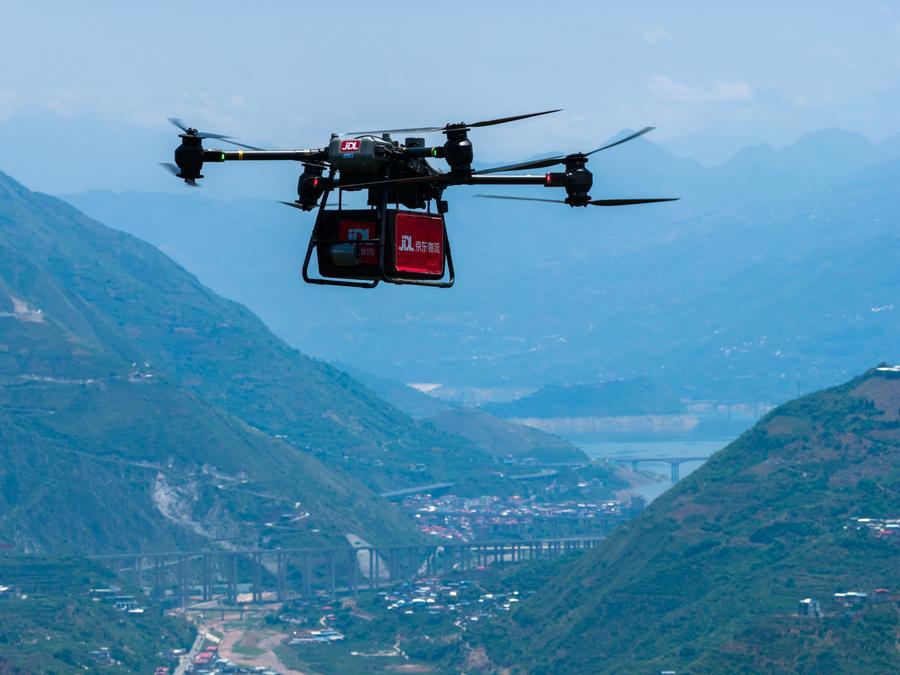
Most drones flying into villages still fly back empty. According to JD Logistics, about 99 percent of return flights on rural routes carry no cargo.
Quxian is trying to change this.
In August, local villager Yu Fengying sent several kilograms of peanuts and sweet potato starch noodles to relatives and friends outside the area. Instead of riding an electric scooter to town, she used a drone that had just delivered parcels to the village.
About eight minutes later, the package reached a central landing point in town and entered the conventional express network.
JD Logistics plans to expand this service across Quxian and use return flights to carry local products including daylilies, lemons and plums.
Farm produce requiring fast transit may be among the more suitable shipments.
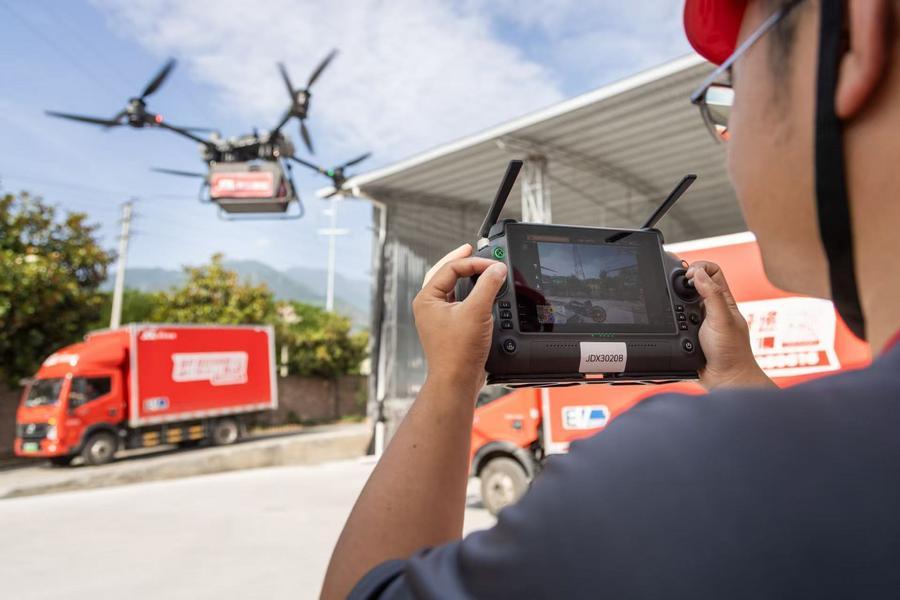
During the 2025 sweet cherry harvest in Hanyuan County, Sichuan, drones carried fruit from mountainous areas to a mail processing center in around 15 minutes. Conventional vehicles needed one to two hours for the same trip.
In the course of a month, more than 550 flights transported 7,586 packages of cherries weighing a total of 22.76 tonnes.
For fresh fruit harvested within a short season, saving an hour or more in transport can help reduce the time between picking and onward shipment.

WHERE DRONES MAKE SENSE
The faster trip does not yet cost less.
On one Zizhong route, JD Logistics puts the comprehensive cost at roughly 5.6 yuan (about 83 U.S. cents) per parcel by drone, compared with 4.4 yuan by vehicle.
Drones carry approximately 30 percent of their available payload on average, while almost all return flights are empty.
Zhang Jianping, director of a low-altitude air traffic institute at Southwest Jiaotong University, said drones are most useful in places where mountains or water make ground transport difficult. Only a few such services have so far reached a scale that can support commercial operations, he noted, while most are still used alongside conventional transport.
Zhang said western mountainous areas have demand for transporting farm produce, daily necessities and engineering supplies, because difficult terrain, large elevation changes and limited road access can make ground transport slower or harder.
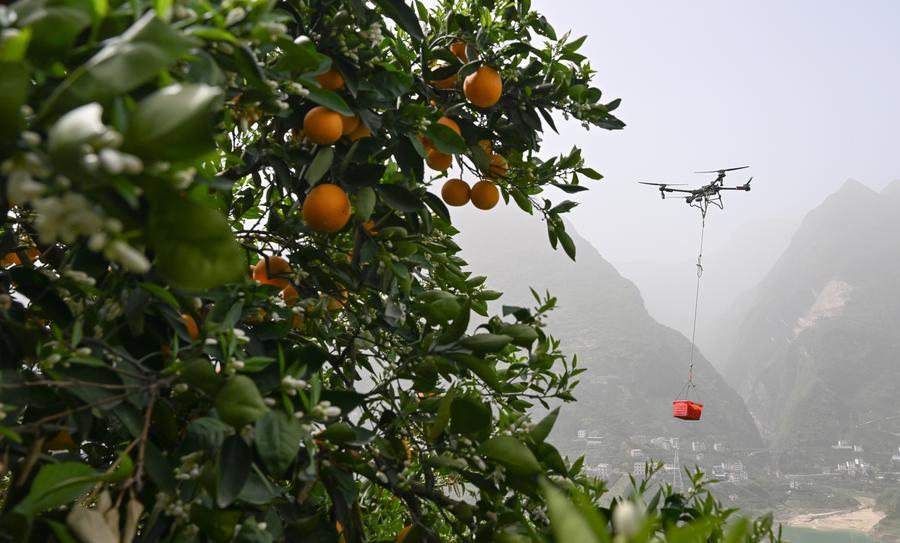
Fangxian County in central China's Hubei Province, meanwhile, is using several transport methods rather than relying on one. A national rural-delivery pilot project there uses conventional vehicles, autonomous delivery vehicles, drones and combined passenger-freight-express mail services, depending on local conditions.
Since the pilot began, average operating cost has fallen by 0.2 yuan per parcel, while daily inbound village mail volume has risen by 16.3 percent and outbound volume by 48.9 percent, according to the State Post Bureau.
In Sichuan, drones are also being used to carry matsutake mushrooms, cherries and highland strawberries, as well as bamboo, power-grid components and construction materials.
JD Logistics plans to expand rural drone services to more than 50 counties and districts across the provincial-level regions of Sichuan, Chongqing, Yunnan and Guizhou, all located in southwest China.
(Video reporters: Lu Youyi, Yang Hua and Xue Chen; Video editors: Hong Ling, Roger Lott and Li Qin)■